Event
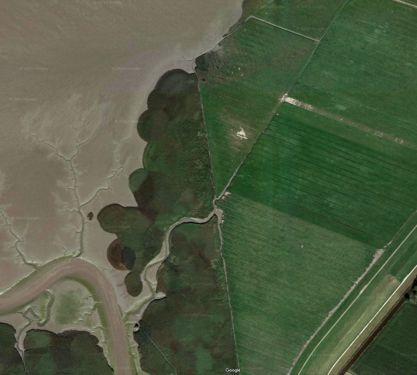
09.06.2026: Ems-Dollard estuary, NL
Initiated: Marjolijn Dijkman
With introductions by Marjolijn Dijkman and physicist Lealia Derickx (X-lab, UHasselt).
Organised by: Marjolijn Dijkman & Ruby de Vos
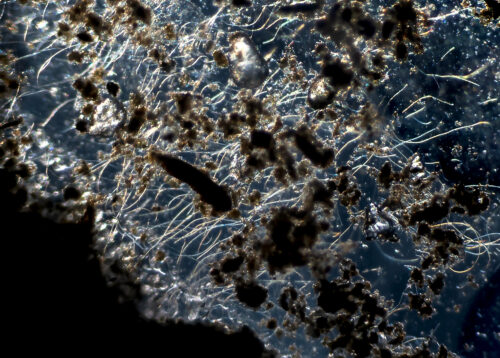
‘Conductive Solidarity’ is an iterative outdoor event on the edge of the Ems-Dollard in which silt samples taken from the tidal flats with cable bacteria are placed under a microscope and projected live on a large screen. This gathering will engage in what Marjolijn has called “collaborative microscopy session”, where we decenter the individual, scientific perspective and instead find collaborative, pluralistic ways of thinking with cable bacteria, embedded in the landscape.
What cable bacteria could to teach us exceeds what any single discipline can offer, from biology and physics to disciplines that have not yet been brought into conversation with them: political theory, post-human philosophy, feminist and decolonial thought, and social studies. This session brings together a range of different researchers and thinkers to set off an interdisciplinary chain of reflections in which we can learn from each other and think together, embedded in the landscape where the cable bacteria live.
* Cable bacteria are tiny microorganisms that live in sediment and conduct electricity through their bodies. What makes them unique is how their cells divide this work: different cells handle different parts of the energy supply, linked by a shared electrical current running the length of the filament. This form of electrical teamwork between cells has not been observed in any other multicellular organism, and gives cable bacteria a profound advantage in environments where resources are spatially separated. They have been living this way for over 560 million years. Their electrical existence was confirmed only in 2019, and they represent a fundamental revision of what life was thought to be capable of.
This workshop is part of Slibfluisteraars, a one-year artistic research project led by Ruby de Vos at Hanze/Minerva Academy, which explores how we can learn to listen and attend to more-than-human perspectives – in this case, to the silt of the Eems-Dollard in Groningen and the living cable bacteria within it.
Supported by: KIEM (NWO), WaterLANDS