Event
2025-2026: KIEM, Ems-Dollard Estuary & Lauwersmeer, NL
Silt Whisperers (Slibfluisteraars)
Support: KIEM MV – NWO (Dutch Research Council)
Research project November 2025 – November 2026
Artists: Marjolijn Dijkman, Linde Ex, Suzanne Luurs, Leonard Witte
Curated and produced by: Ruby de Vos, senior researcher, Research Center Art & Society at Hanze University of Applied Sciences, Groningen, NL
Consortium partners: Klaei B.V. and Sense of Place B.V.
The transition to sustainable material use requires not only technical solutions but also new ways of dealing with materials – including attention to more-than-human interests. Siltwhisperers investigates how artists can make more-than-human perspectives tangible and relatable, so that the transition to sustainable material use occurs holistically, with attention to both people and the planet. The research responds to developments surrounding the use of sludge on the Groningen coast. In the Wadden Sea and near the Eems-Dollard, the amount of sludge in the water has a significant impact on local ecosystems. Dredged sludge can potentially be used in agriculture, construction, design, and nature restoration. These developments, therefore, bring together various ecological, economic, and sociological interests and values. Slibfluisteraars argues that concretizing more-than-human perspectives is an urgent intervention in this context, enabling the processes of value attribution in transitions to be critically examined and questioned.
However, this requires imagination. That is why artist-researchers are working with our practice partners to develop listening methods for participatory workshops. In these workshops, they explore strategies for learning to listen to the sludge and reflect on its impact, together with stakeholders such as policymakers, residents, researchers, and entrepreneurs. In an iterative process, the developed methods are tested, evaluated, and refined in phases, creating a continuous cycle of co-creation and reflection. The methods developed during this research project thus offer an alternative entry point into existing discussions in the living and working environment regarding sustainable materials.
Although the workshops are experimental research spaces in a specific context, the insights they provide extend beyond this. This research yields practical methods and insights for incorporating more-than-human perspectives into policy-making, design, and material use. This approach contributes to a just, ecologically responsible transition to sustainable materials.
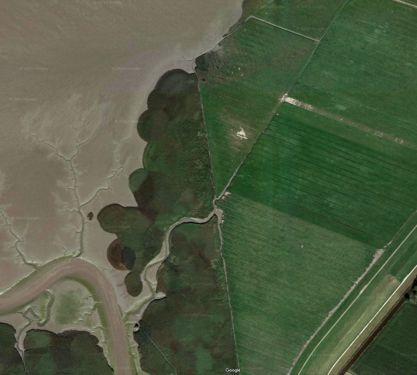
Image: M. Dijkman